Years 2–6
Primary Track
Foundational engineering, robotics confidence, building, coding foundations, teamwork and problem-solving through guided projects.
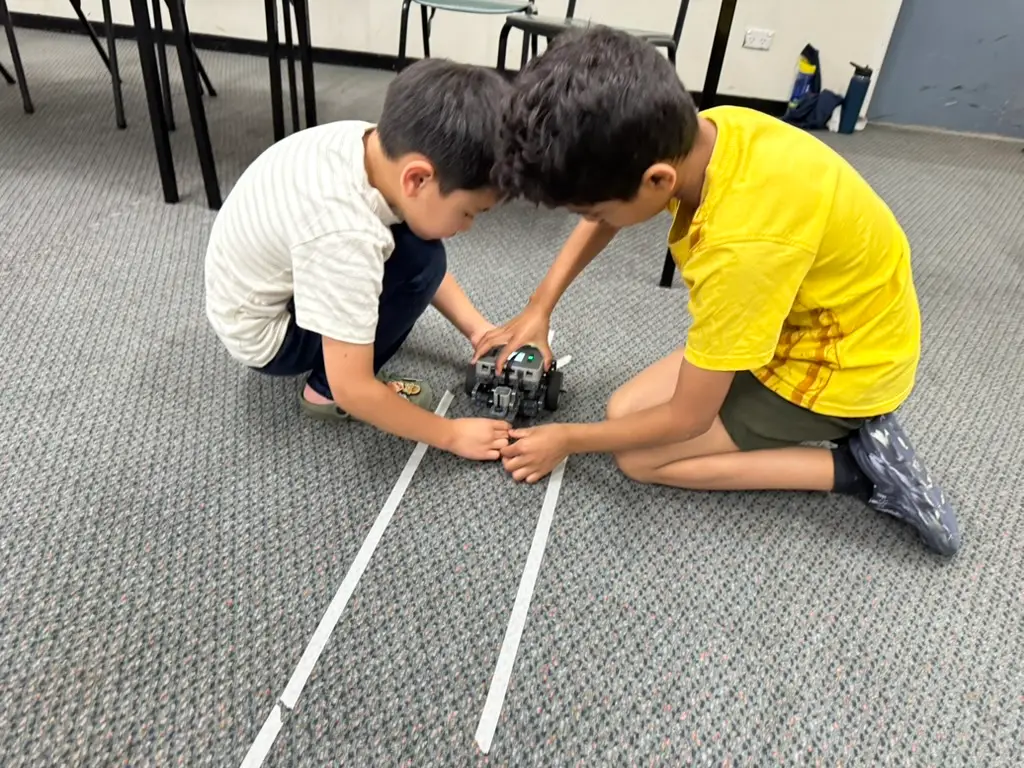
Robotics & Computer Science
Where students learn to think like engineers. Students design, build, program, test and refine real robotic systems through structured projects that bring together engineering, coding, problem-solving and systems thinking. Term classes for Years 2–8.
Programme overview
The Applied Robotics & Engineering Academy helps primary and secondary learners develop engineering thinking, problem-solving, confidence and systems understanding through practical robotics challenges.
Students work through guided projects that ask them to plan, build, program, test, identify problems, iterate and improve — learning through experimentation and persistence rather than simply following construction instructions.
Practical building is supported by essential engineering theory, so students understand why a system behaves as it does — not just how to assemble it.
Core learning cycle
Engineering is an iterative process. Students develop an idea, build and program a system, observe what happens, identify problems and make purposeful improvements. A solution does not need to work perfectly the first time — testing and refinement are part of the learning.
Student learning tracks
Years 2–6
Foundational engineering, robotics confidence, building, coding foundations, teamwork and problem-solving through guided projects.
Years 7–8
More complex engineering challenges, deeper systems thinking, increased independence, more advanced programming, testing and optimisation.
Years 9–12
Advanced coaching and mentoring — complex robotics projects, competition preparation, technical mentoring and pathway development towards senior secondary study. Arranged separately from the Years 2–8 term classes.
Why families choose us
Students work with physical robotic systems — motors, sensors, mechanisms and controllers. Active creation, not screen-only learning.
Block-based and, where appropriate, text-based programming makes robots behave purposefully and solve real challenges.
Primary and Lower Secondary tracks adjust projects and expectations to each learner’s experience and progression.
Optional certification opportunities recognise learning milestones and support student motivation.
Experienced robotics coaches guide students through questions, feedback, practical challenges and problem-solving.
Programming is balanced with hands-on building, testing and teamwork. Technology is a creation tool, not passive consumption.
Curriculum & learning focus
Core learning platform
VEX IQ is the primary platform in the Academy — an internationally used educational robotics system that lets students explore mechanical construction, motors, gears and mechanisms, sensors, controllers, coding, autonomous behaviour and engineering challenges.
Edison · Ozobot
VEX V5 · Arduino systems
Different platforms may be introduced where appropriate to the learner, project, progression and available programme resources.
As students progress, selected projects may introduce:
A practical, supportive and inclusive small-group environment. Students learn through questions, experimentation, constructive feedback, testing, reflection and iteration — guided by our Coaching · Mentoring · Care approach.
A structured, term-based after-school programme of 8 sessions per term, designed for progressive development — not a one-off workshop.
Years 2–8 learners who:
No prior robotics or coding experience is required.
Forge Learning Platform
The Forge Learning App complements the physical robotics experience with coding pathways, robotics reflection journals, certification tracking, project portfolio evidence and AI-supported practice.
Learning progression
Multiple terms allow greater depth, but students can enter at any term starting point.
Learn foundational building, coding and robotics concepts through guided projects.
Build stronger mechanical, coding and systems understanding.
Use skills to solve increasingly complex engineering challenges.
Explore advanced robotics, engineering, coding and competition opportunities where appropriate.
Joining the academy
Each term introduces new projects, so suitable new students can join without completing earlier terms, while returning students are challenged at the right level. Not sure where to begin?
What might students work on?
Projects vary by term and progression. Examples include:
Engineering + coding
Software decisions affect physical behaviour, and mechanical decisions affect what software can achieve. Robotics connects engineering, coding, mathematics, design, systems thinking and problem-solving.
2027 classes & enrolment
In-person term classes. Each location runs on its own weekday, and every term is 8 weeks.
$380 per term
Enrol Now$380 per term
Enrol Now$380 per term
Enrol NowRobotics classes are available only at the locations listed. View all learning locations
Term schedule
Full payment is required before each term begins to confirm a student’s place. Standard terms and conditions apply.
New to the academy?
A Starter Session gives students an opportunity to experience the Academy’s hands-on learning approach before joining a full term. Students meet the learning environment, try an age-appropriate robotics activity and discover whether the programme is a good fit.
We want every student to participate meaningfully. If your child has additional learning needs, contact us before enrolment so we can discuss the programme environment and appropriate support.
We can provide invoices and receipts for self-managed or plan-managed NDIS participants. Email us your NDIS plan type after enrolment.
Innovate Forge Academy builds on a deep heritage of robotics competition preparation. Students can explore competition and challenge opportunities as they become available — separate from term enrolment.
Explore CompetitionsThe Applied Robotics & Engineering Academy builds on the established robotics education experience of Innovate Technology & Robotics Academy and now forms part of the broader Innovate Forge Academy learning model.
From our families
“What an incredible experience and wonderful memories made over the year! Thank you team for making this happen. Sue and Gary, we cannot thank you enough for motivating and guiding them all the way. ❤️”
“Thank you Sue and Gary! Encourage them to be themselves! It’s so good to know new friends, not just children, but also parents! Wish you all the best!”
Frequently asked
No. Beginners are welcome and no prior robotics or coding experience is required. Experienced students are challenged at an appropriate level.
VEX IQ is the primary learning system. Edison, Ozobot, VEX V5 and Arduino may be introduced where appropriate to the learner, project and progression.
Yes. Programming is applied directly to robotics challenges — students see their code move and control a physical system, rather than learning coding only on screen.
No. Students develop engineering design, coding, testing, systems thinking, problem-solving and iteration skills.
Each term introduces new projects and engineering challenges, so learning keeps progressing over time.
Yes. Students may join at the start of any term. Each term introduces new projects so new students can enter without disadvantage.
Each term runs for 8 weekly sessions of 90 minutes. Many families continue across multiple terms to build greater depth.
$380 per term. A Starter Session is $50.
2027 classes run at Forest Hill College (Mondays), Narre Warren (Tuesdays) and Chadstone (Thursdays).
A guided, hands-on introductory session where students try an age-appropriate robotics activity and discover whether the programme is a good fit. View Starter Sessions.
Enrol online at enrol.innovateforgeacademy.com. Full payment confirms a student’s place before the term begins.
Yes. The Forge Learning App supports coding pathways, robotics reflection journals, certification tracking, project portfolios and AI-supported practice.
Competition and challenge opportunities may be available separately and are not automatically included in term enrolment. Explore competitions.
Ready to join?
Explore current Applied Robotics & Engineering Academy sessions and enrol your child for the 2027 programme.